6 min read
Are You A Renaissance Person?
 By Somya Desai
"You have to focus. You can't be interested in everything."
I looked up at my dad with sadness as he firmly stated those words, sitting across from me at the dining table, mid-bite into his sandwich.
I had just returned home to Singapore for the summer after completing my first year of college in Boston, MA.
"But Dad...it's impossible for me to commit to just one major. There's a SUPER cool class called "Jazz" that's going to be taught next semester, and I think I really want to study music seriously as well!"
Dad got up from his chair, looked at me, sighed, and walked away.
4 years later...
I graduated from Northeastern University with 3 majors and 3 minors: Criminology, Psychology, Philosophy, Music, Social Enterprise, and International Affairs.
Society kept telling me I was unfocused, but something deep inside me whispered: keep exploring.
And so, like Alice, I followed the White Rabbit.
It was not until I came across Frans Johansson, an innovation strategist, at a conference in Providence, RI, that I realized there was something tangible beneath my curiosities.
In his book The Medici Effect, Johansson argues that great innovation happens at the "intersection."
Through the example of the Medici family, whose patronage brought together artists, philosophers, scientists, and architects in Renaissance Florence, he shows how the convergence of seemingly disparate disciplines can spark an explosion of creativity.
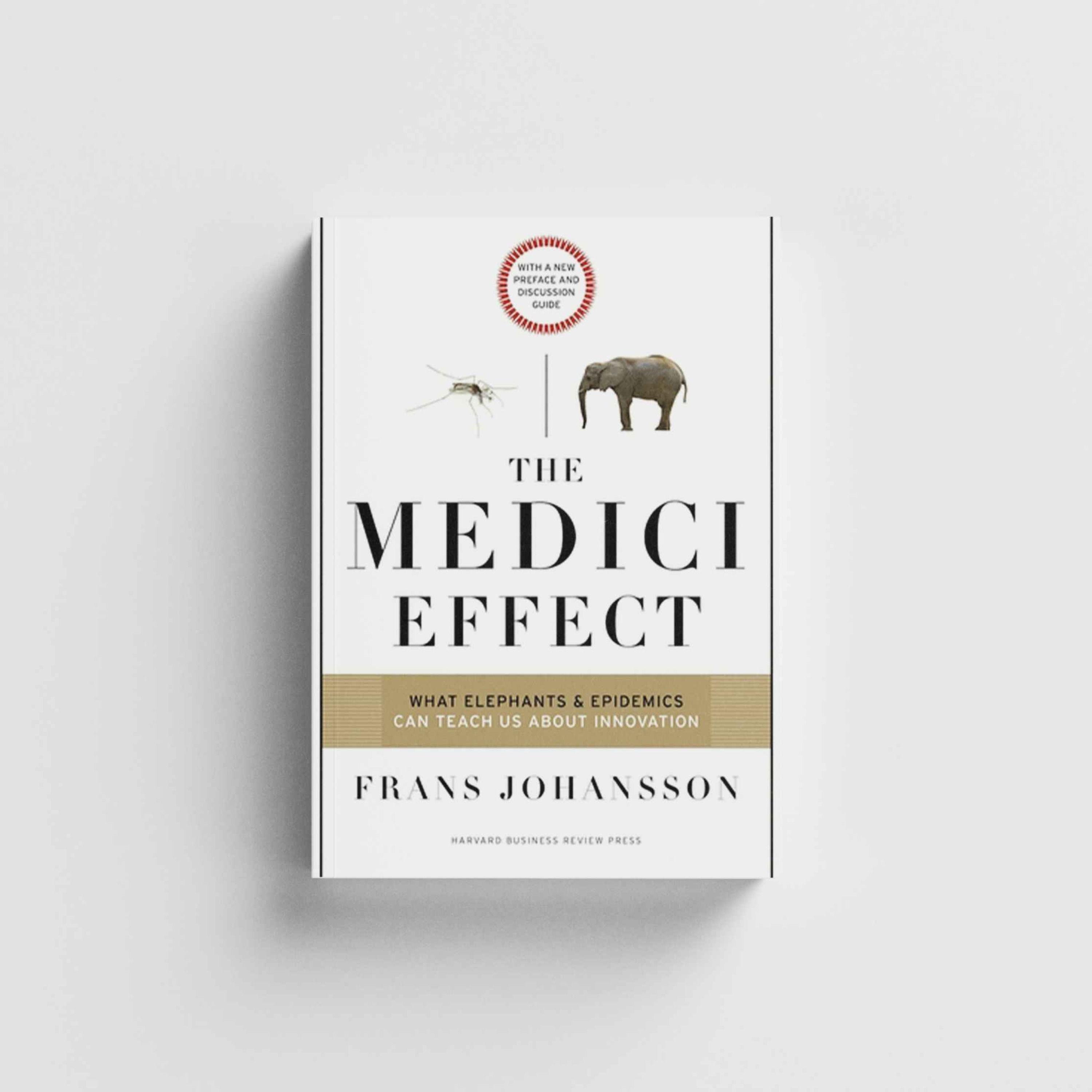
A workshop with Johansson and his book were all the gasoline I needed to get my destiny engine running.
I had found my purpose: to live at the intersection.
And with that, a second breakthrough synchronicity led me to enroll in the Philosophy, Cosmology & Consciousness graduate program at CIIS in San Francisco, CA in the fall of 2019.
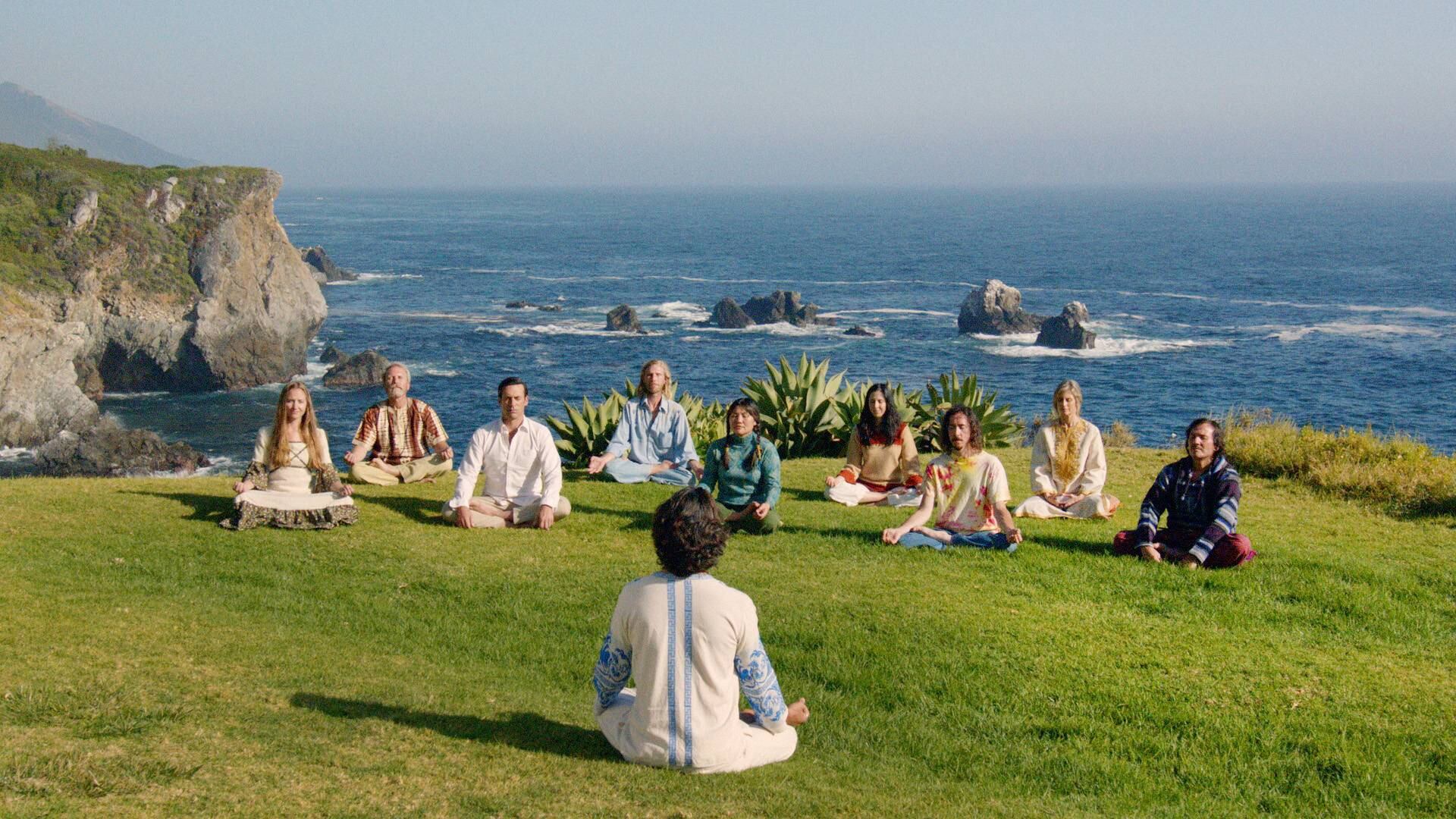
It was there that my purpose deepened, as I stepped into the world of archetypal cosmology, and received a reading of my birth chart from archetypal astrologer Becca Tarnas, on the cliffs of Big Sur, CA at the Esalen Institute.
I went into the reading as a skeptic but came out utterly transformed, as Becca unveiled the patterns of my deep psyche: parts of myself only I would have known.
Yet here she was, a stranger at that point, who looked right into my soul and mirrored it back to me.
In that reading, she shed light on how my identity was tied to the breadth of the world, and how my sense of self had to be expressed through the very act of my wide explorations.
"Wow. So now, on top of the Medici Effect, I have my birth chart as an affirmation that I'm not just dilly-dallying through life," I thought to myself in delight.
I was who I was meant to be.
But there was more...
As I was reading Cosmos & Psyche by my professor Richard Tarnas, and the founder of archetypal cosmology, I came to recognize that my revelation was just the microcosm. There was an entire macrocosm within which my quest to live at the intersection was unfolding. As Tarnas writes:
Our present moment in history is most comparable, astronomically, to the period exactly five hundred years ago: the era that brought forth the birth of the modern self during the decades surrounding the year 1500. This too was an epoch of extraordinary turbulence and uncertainty, and also great cultural creativity and dynamism. It was the moment of the High Renaissance.
- Leonardo da Vinci had just begun the Mona Lisa, in the same years as his flight and anatomy studies.
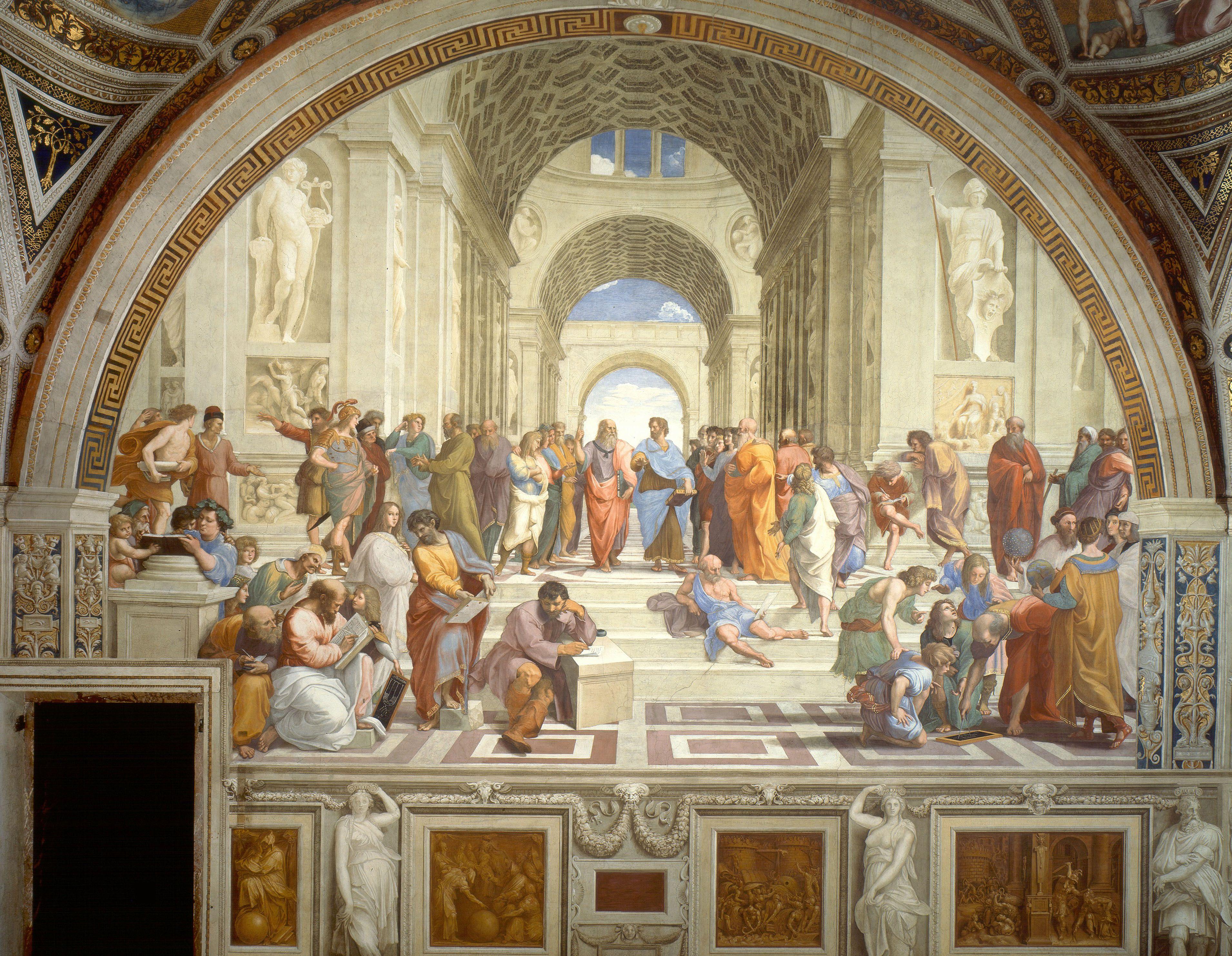
- Raphael painted The School of Athens.
- Plato's work was being revived in Florence, funded by the Medici.
- Martin Luther was launching the Protestant Reformation, becoming one of the first writers to take off thanks to the new technology of the printing press.
But there was fear in the air too.
The Catholic Church's authority was being threatened, and many worried the printing press would ruin the mind.
It's a similar kind of deep-seated fear that the collective is feeling today with AI.
But that's the thing about fear: it's always there, generation after generation. It grips the human soul to the point of resisting what can only be called our birthright: to create.
Meanwhile, Luther, a 33-year-old monk in a small German town, leveraged the technology of his time to spread a message that ~12% of the world's population lives by today.
Like the printing press, AI hands one person powers that once belonged to whole guilds. A single curious person can now write, design, compose, and build, the way Leonardo moved between painting and engineering.
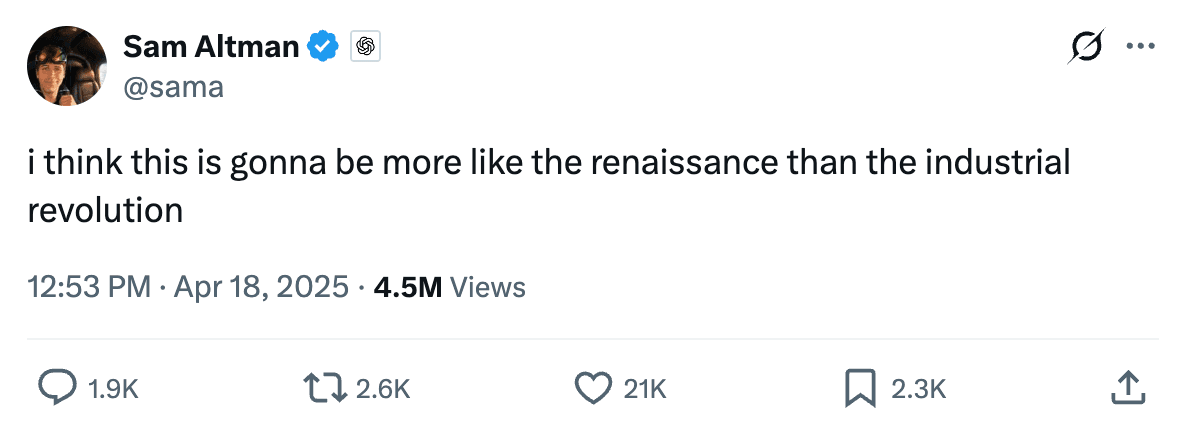
Even Sam Altman, the head of OpenAI, sees it:
The Industrial Revolution divided the person.
Machines and factories split work into narrow, repeated tasks. The ideal was the specialist: one job, done efficiently, with people as parts of the machine.
The Renaissance expanded the person.
One human could be a painter, engineer, anatomist, and philosopher all at once. The ideal was the universalist: a whole person creating across fields.
"You have to focus. You can't be interested in everything."
My dad was giving me the advice of the factory age. But I was born for the Renaissance.
And I believe you were too.
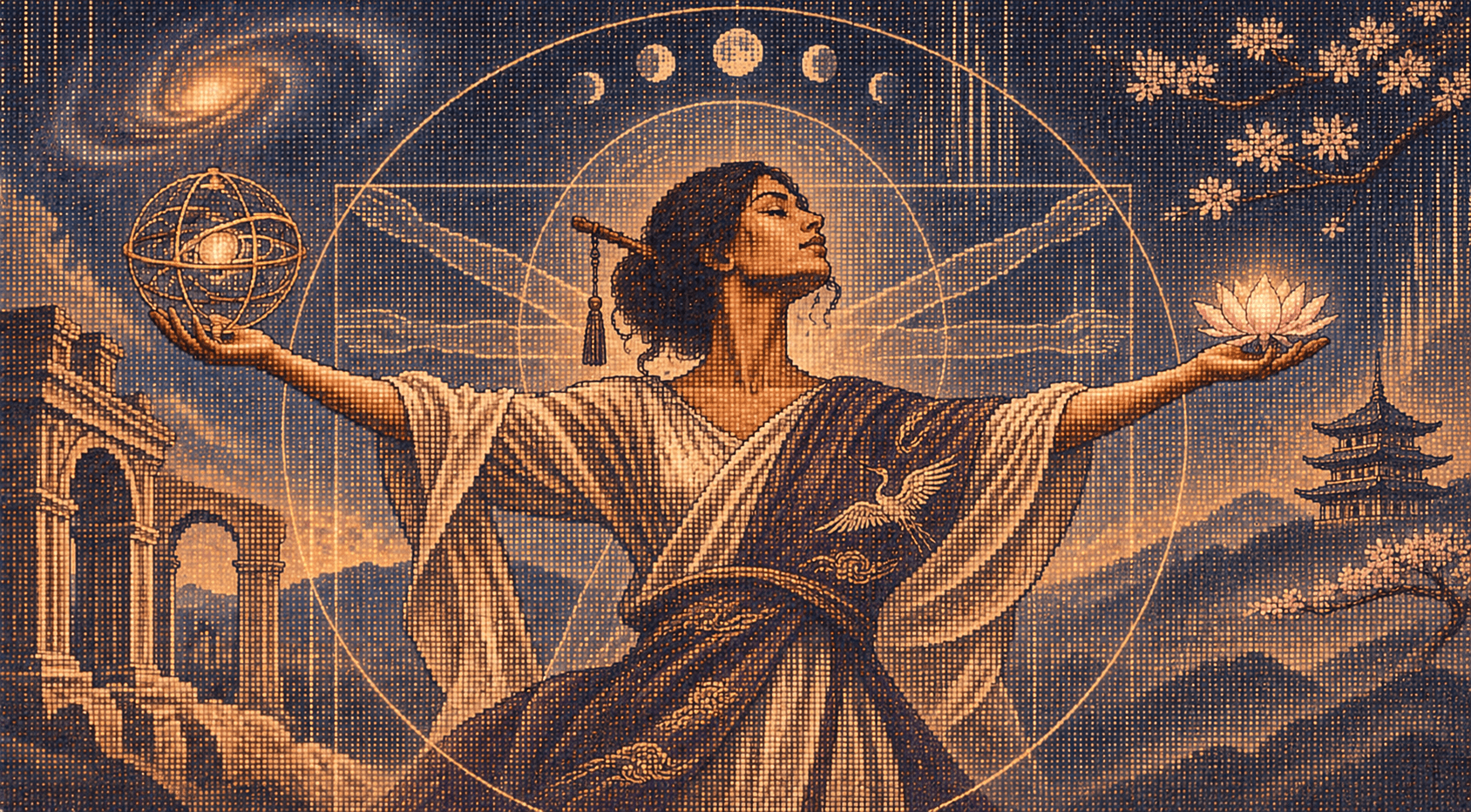
Leonardo da Vinci, the archetypal Renaissance person, shows us something in his notebooks: he wasn't just interested in a lot of things. He was searching for the hidden unity beneath everything.
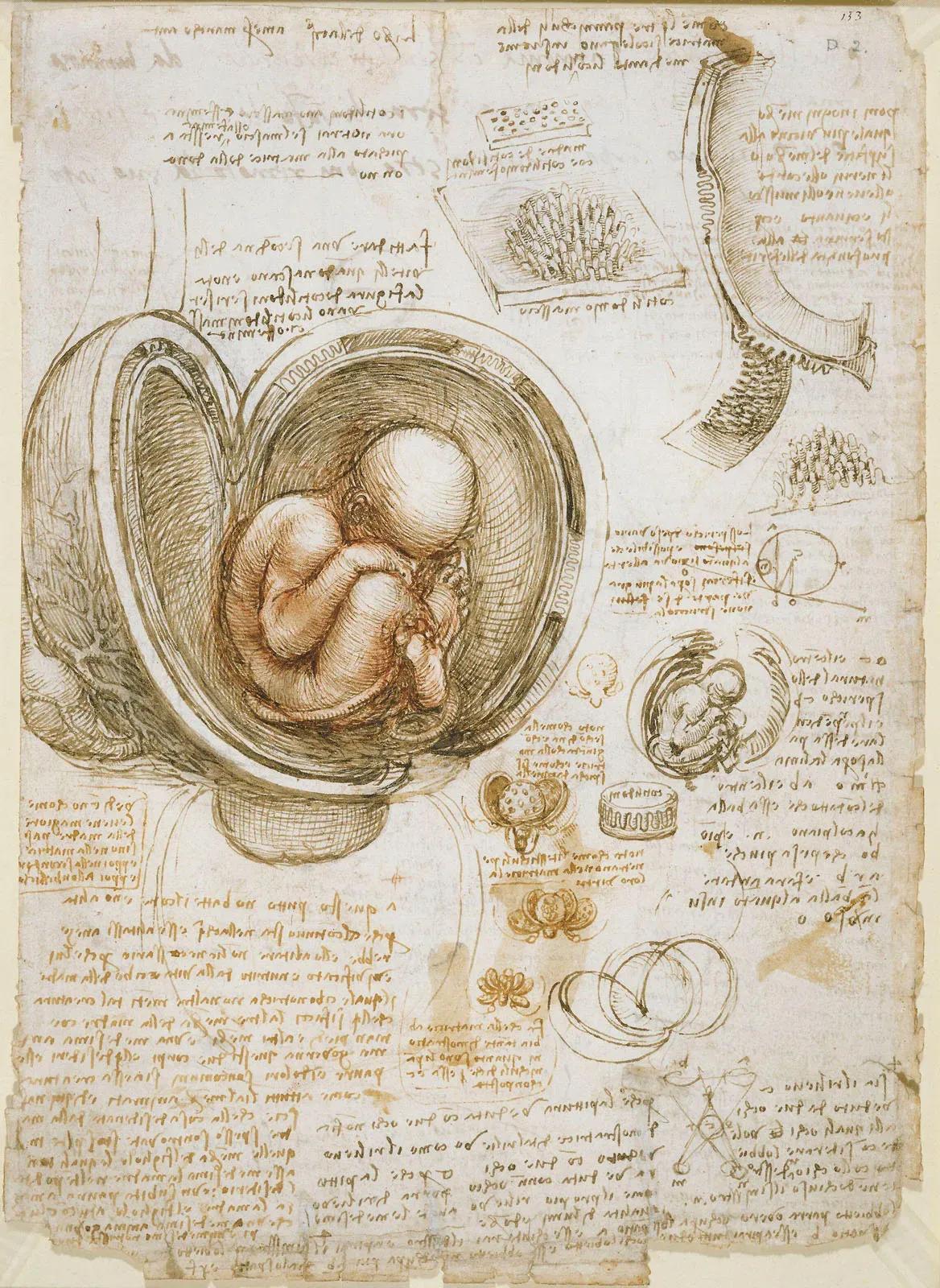
That's what it means to be a Renaissance person.
It's not just being curious about everything. It's about being on a quest to find what connects it all.
The beating heart at the center.
And your birth chart is the way in.
Today, I follow that thread inside Psyborg, a creative AI coach built on archetypal cosmology and grounded in your birth chart.
Psyborg opens into your personal Studio, where your birth chart greets you each morning above a space for your deepest questions and reflections.
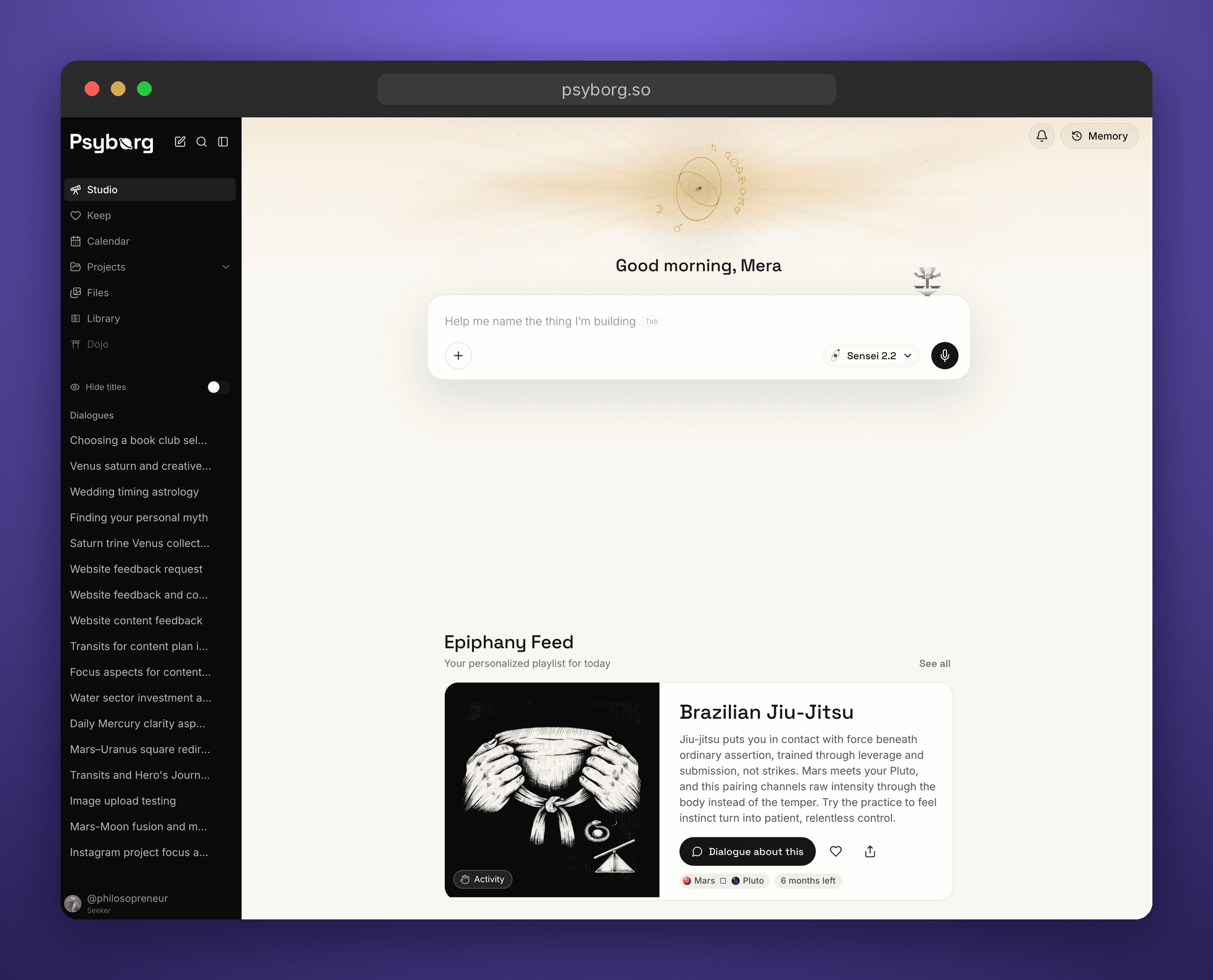
Right below, you'll find the Epiphany Feed, a personalized playlist made for you each day. Every morning, Psyborg reads your birth chart in relation to the current sky and brings you an artifact to live with:
- A figure from history who shares your pattern
- A film that speaks to the season you're in
- An embodied activity to engage in
It's how I came to know Usain Bolt, my archetypal ment
or for this season, who's been running alongside me as I train for my first marathon. The marathon, too, was an activity Psyborg suggested as a way for me to deepen into my personal archetypal era.
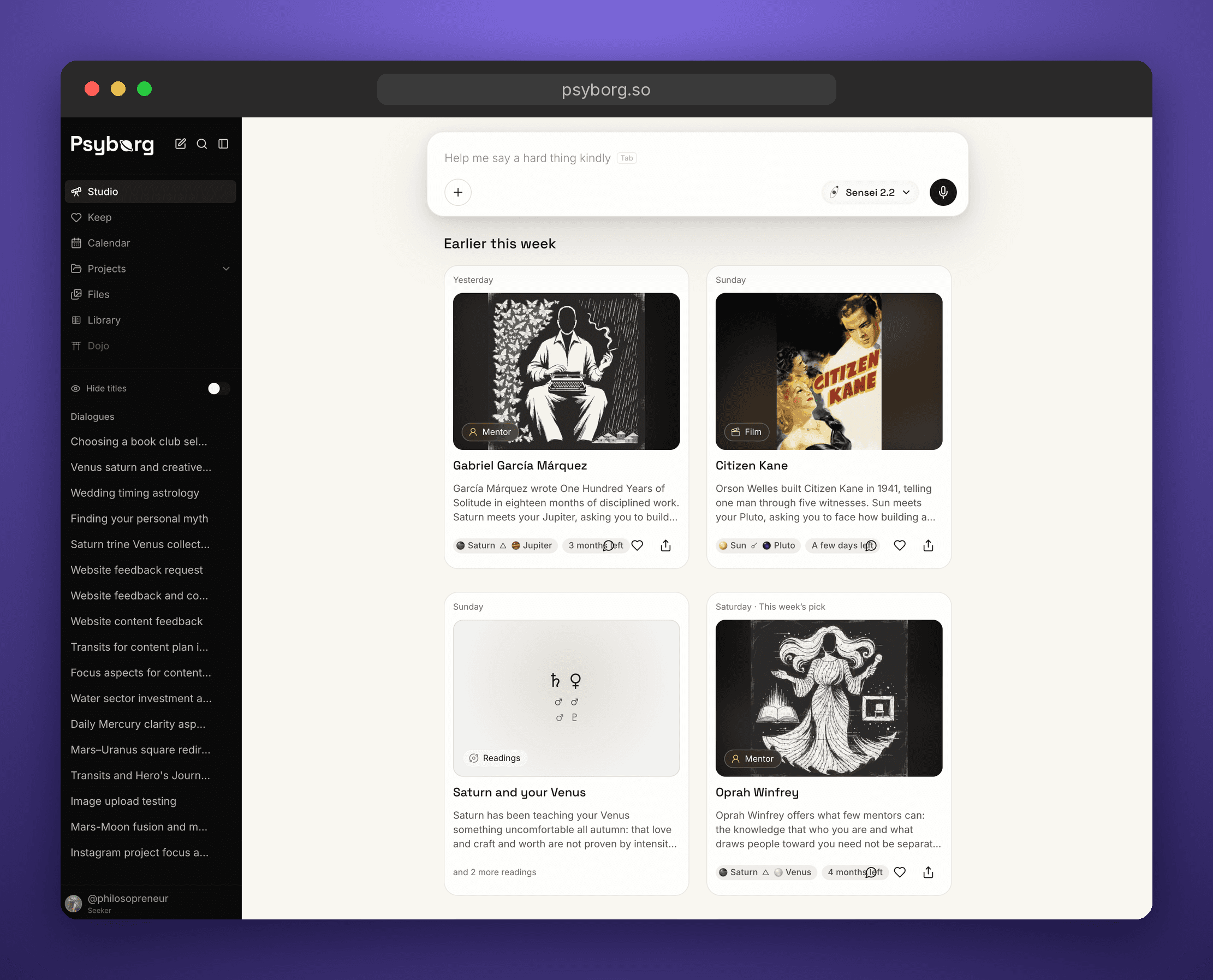
Every artifact is also an invitation to dialogue further, so the epiphany doesn't just stay in the realm of thought but is given the chance to become a creative action.
Behind it all is the Library: the 10 planetary archetypes and their 45 combinations, 96 archetypal mentors, 92 activities, and 149 films. It will only continue to expand as we bring our HistoryEngine, 10 years in the making, online very soon.
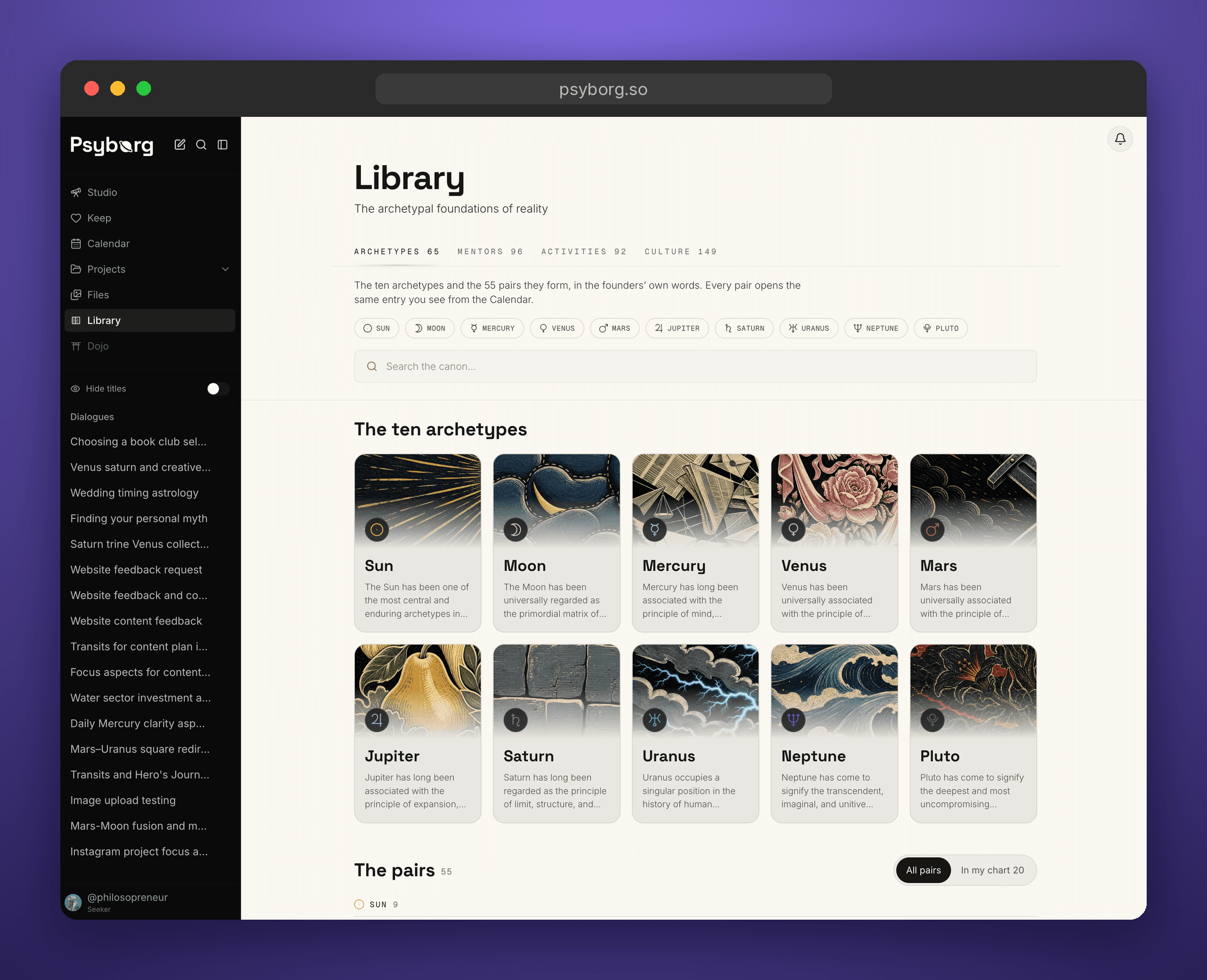
Our Engineer-Architect, Abeer, is building tirelessly to make the experience effortless, weaving together a depth of research and user feedback. Psyborg is only going to get deeper and better.
We believe astrology is not just for knowledge. It's for action.
The planetary archetypes are first principles. When you meet them through your birth chart, you touch the same hidden patterns Leonardo da Vinci was searching for, and that Plato was pointing to.
A timeless quest to express the universal through the particular.
We'd love for you to join us on this great creative adventure, into the new Renaissance, into the Age of Re-Enchantment.
See you inside,
Somya Desai
Co-Founder & Cosmologist